Introduction
There are plenty of examples of Smart Goals for Math Teachers floating around on the web, but there aren’t many lists that include what really works: goals that are based on your grade level, and supported by real classroom data. Indeed, the recent national evaluations reveal that U.S. mathematics performance varies significantly across grade levels, while an increasing number of educators are experimenting with AI to bridge this divide. This article includes 12 practical SMART goals for each grade band, a fill-in-the-blank template, some common pitfalls to avoid, and a quick checklist for monitoring progress throughout the school year. From counting 1st grade to calculus in the senior year, there’s a goal to match your classroom’s needs now.
What Makes a SMART Goal for Math Teachers?
SMART stands for Specific, Measurable, Achievable, Relevant and Time-bound. Every word pushes you to make a general wish more concrete to make it actionable! The goal “Improve at teaching fractions” does not say what to do on Monday morning. A SMART version does.
Here’s how it works. A SMART goal is “Increase my 6th grade average on fraction quizzes from 68% to 78% over the next 9 weeks by incorporating 2 brief fraction quizzes weekly.”
This one sentence addresses who (6th graders), what (fraction quizzes), how much (68% to 78%), how (weekly practice sets) and by when (nine weeks). Each example in this goal is tagged the same way, and each example is tagged to indicate which part of the goal applies to which letter.
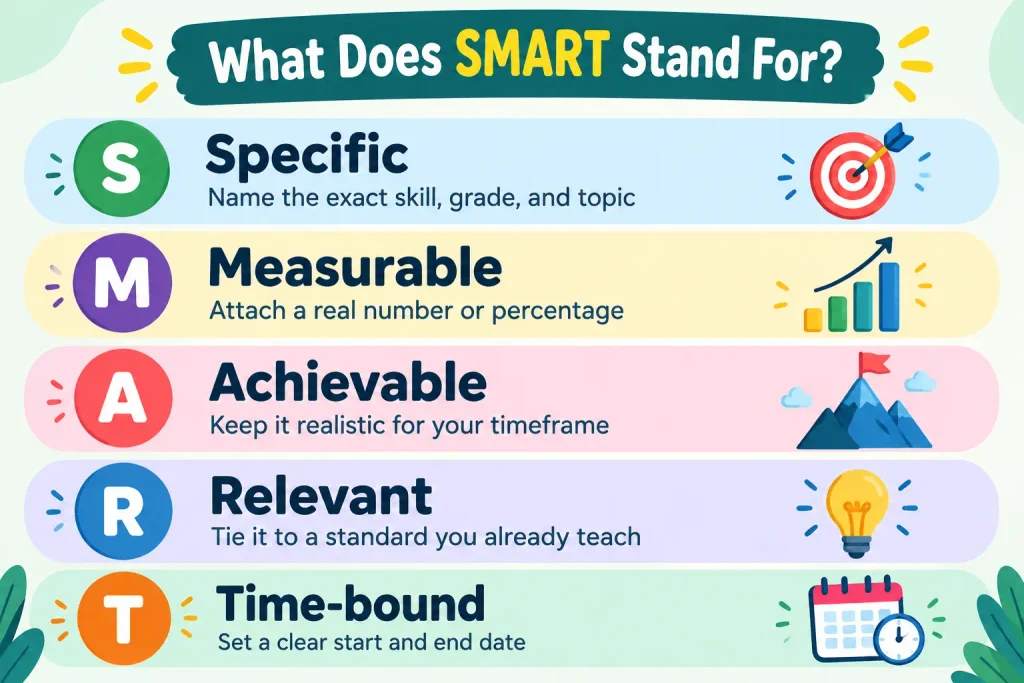
Imagine that each letter is a filter that your target has to pass through before it can be used. Goals without a percentage, score or count will be difficult to assess at the end of term if they don’t meet the “measurable” filter. One that fails “achievable” puts you on the path to burnout rather than to progress. This only takes a few seconds to set up, but can save hours of frustration later on.
It is also a good idea to distinguish between goals related to student outcomes and goals related to what you do. Both are valid uses of the SMART format — one is measured by student data (test scores, exit tickets, etc.), the other by your actions tracked (lessons planned, sessions conducted, etc.). Clear goals contain the type of goals clearly stated.
Why Math Goal-Setting Matters Right Now
National mathematics scores provide teachers with a good reason to set targets with genuine urgency, rather than merely as a back to school routine. Math performance at grade 4 increased, at grade 8 it was unchanged, and at grade 12 it decreased in the 2024 NAEP. Math scores were higher at grade 4, the same at grade 8, and lower at grade 12 in 2024 NAEP scores than in 2022. International comparisons indicate the same pattern – about a third of U.S. students performed at the low end in math in the 2022 PISA assessment, ranking the nation 27th among 81 countries.
Those numbers are not meant to discourage you! They’re a reminder that specific, measurable objectives are important in math and more important in many other subjects, for the gaps are broad and they’re widening without intervention.
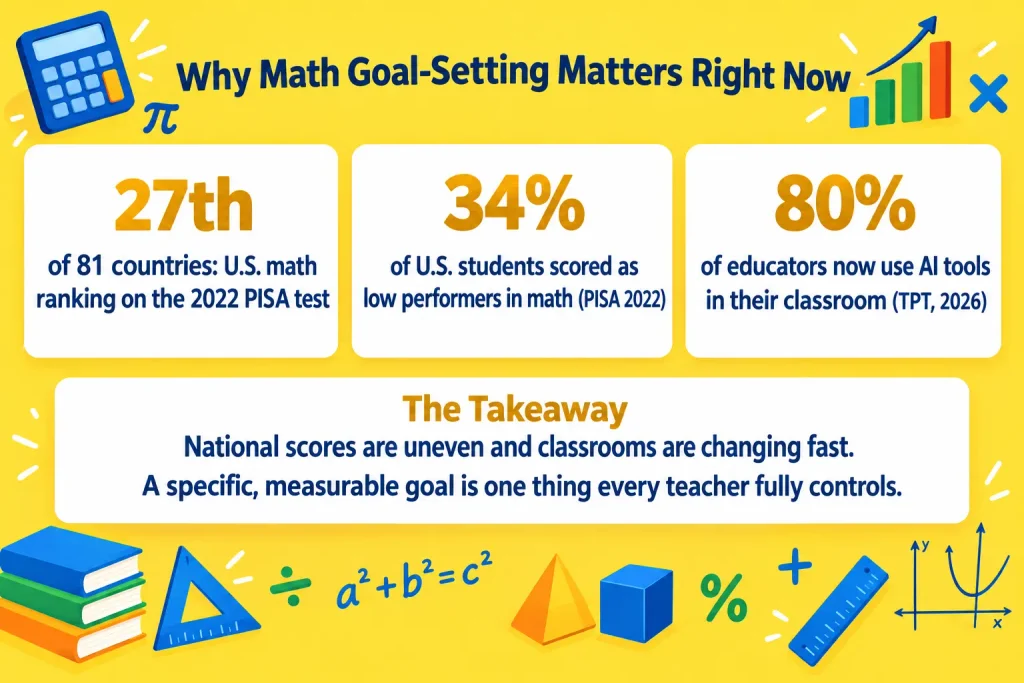
Classrooms are evolving rapidly, while the same time. Nationally representative research, reported in Education Week, revealed that the percentage of math teachers employing AI tools for instructional planning almost doubled year over year, and in a research report from the education marketplace TPT, 80% of teachers today use generative AI tools in their classroom in some capacity, compared to 38% in 2026. If you haven’t already established a goal for the use of any of these tools, now is a good year to get started.
Nothing of this implies that all goals need to be chasing a national statistic. The baseline of your classroom is more important than the average, and the point of examining NAEP or PISA data is not to compare to a number in a far away land, but to understand that one of the few things a teacher can control is a well-constructed goal amid a much more urgent challenge in the nation’s math curriculum. Attendance policies, funding and curriculum adoptions occur outside of your pay grade. What you teach on Tuesday and how you measure it does not.
12 Examples of Smart Goals for Math Teachers by Grade Level
Generic goal lists rarely work because a kindergarten teacher and a calculus teacher are solving completely different problems. The goals below are grouped by grade band so you can pick one that actually fits your classroom.
Elementary Math Teachers (K–5)
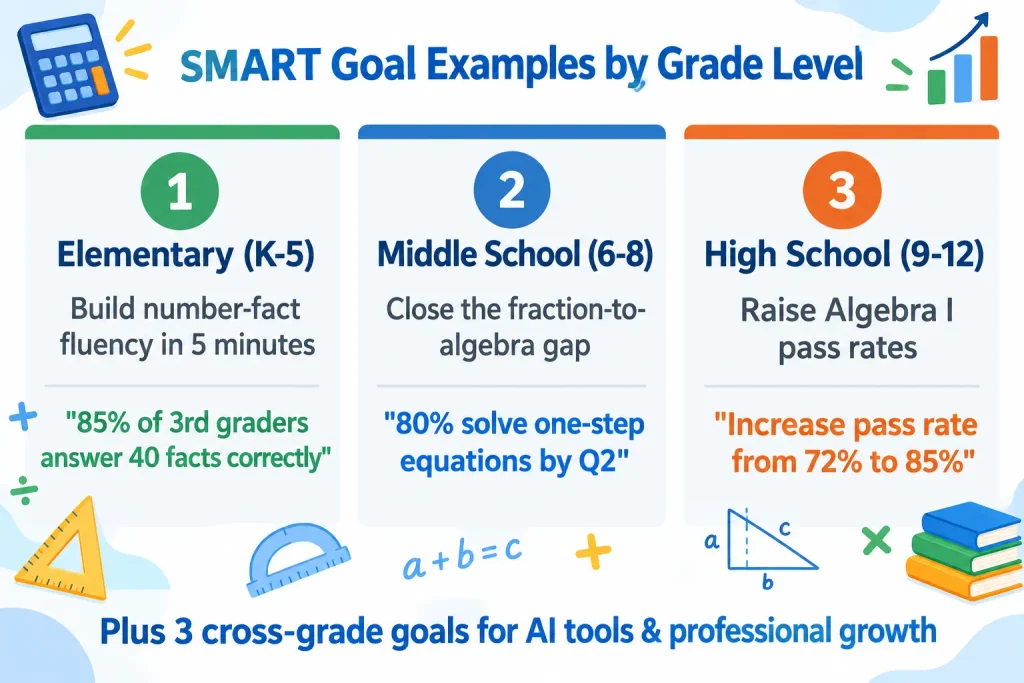
1. Build Number Fact Fluency “By the end of the semester, 85% of my 3rd-grade students will correctly answer 40 addition and subtraction facts in five minutes, up from a 60% baseline, using daily two-minute timed drills.”
- Specific: addition/subtraction fact fluency in 3rd grade
- Measurable: 85% target from a 60% baseline
- Time-bound: by end of semester
2. Strengthen Early Fraction Concepts “Within eight weeks, 75% of my 4th-grade students will correctly represent fractions on a number line, tracked through bi-weekly exit tickets and hands-on fraction bar activities.”
- Specific: fraction representation for 4th grade
- Measurable: exit ticket accuracy rate
- Time-bound: eight weeks
3. Reduce Math Anxiety Through Games “I will introduce one math game per week for a full grading period, tracking student self-reported confidence through a short weekly survey, aiming for a 20-point increase in average confidence scores.”
- Achievable: one short game weekly, low prep
- Relevant: confidence directly affects performance
- Time-bound: one grading period
Middle School Math Teachers (6–8)
4. Close the Fraction-to-Algebra Gap “By the end of the second quarter, 80% of my 7th-grade students will solve one-step algebraic equations involving fractions, measured against a quarterly benchmark test, up from 55% on the pre-test.”
- Specific: fraction-based algebra for 7th grade
- Measurable: benchmark test comparison
- Time-bound: end of second quarter
5. Increase Homework Completion “I will reduce missing homework assignments by 30% over six weeks by offering a 15-minute lunchtime homework help session twice a week, tracked through a shared spreadsheet.”
- Measurable: 30% reduction, spreadsheet tracking
- Achievable: two short weekly sessions
- Time-bound: six weeks
6. Improve Word Problem Comprehension “Over one semester, I will increase the percentage of students who correctly identify the operation needed in multi-step word problems from 50% to 70%, using weekly problem-of-the-day warm-ups.”
- Specific: operation identification in word problems
- Measurable: 50% to 70% improvement
- Time-bound: one semester
High School Math Teachers (9–12)
7. Raise Algebra I Pass Rates “By the end of the school year, I will increase my Algebra I pass rate from 72% to 85% by adding bi-weekly small-group re-teach sessions for students scoring below 70% on unit tests.”
- Specific: Algebra I pass rate improvement
- Measurable: 72% to 85%
- Time-bound: full school year
8. Prepare Students for Standardized Testing “Starting in January, I will run one 20-minute SAT/ACT-style math warm-up per week through May, aiming for a 10-point average score increase on practice sections.”
- Relevant: directly tied to college-entrance outcomes
- Measurable: 10-point score increase
- Time-bound: January through May
9. Strengthen Geometry Proof Writing “By the end of the unit, 75% of my Geometry students will write a complete two-column proof independently, assessed through a rubric-scored quiz, up from 40% at the unit’s start.”
- Specific: proof-writing skill for Geometry
- Measurable: rubric-scored quiz results
- Time-bound: end of the unit
Cross-Grade Goals: Technology, AI Tools & Professional Growth
10. Adopt One AI Tool for Lesson Planning “Within the first nine weeks of the semester, I will use an AI planning tool to generate and adapt differentiated word problems for at least two lessons per week, tracking time saved compared to my prior planning process.”
- Specific: AI tool use for differentiation
- Achievable: two lessons weekly
- Time-bound: nine weeks
11. Increase Real-Time Formative Assessment “I will use a digital exit-ticket tool after every lesson for one grading period, reviewing results within 24 hours to adjust the next day’s instruction.”
- Measurable: exit tickets after every lesson
- Relevant: directly informs next-day teaching
- Time-bound: one grading period
12. Build a Peer Collaboration Habit “I will meet with one other math teacher every two weeks for a full semester to review student data and share one new strategy per meeting, documented in a shared log.”
- Specific: bi-weekly peer collaboration
- Measurable: documented shared log
- Time-bound: one semester
A Fill-in-the-Blank SMART Goal Template for Math Teachers
If none of the above 12 examples matches your situation, create a custom one following this format:
By [specific date/timeframe] [percentage/numbers] of my [grade level] students will [specific math skill/behaviour] as measured by [specific assessment/tracking method] (from baseline of [current number] students will be able to [specific math skill/behaviour] through [specific weekly/biweekly action]).
Choose a number from your grade book, not a best guess, to enter in each bracket. It’s easier to achieve and much easier to demonstrate that you achieved it when it comes to an evaluation or parent talk.
Common Mistakes Math Teachers Make When Setting SMART Goals
Even experienced teachers fall into a few predictable traps when writing these goals.
Skipping the baseline. A goal that says “improve test scores” without stating the current score isn’t measurable — it’s a hope. Pull last term’s data before you write anything.
Setting goals that aren’t student-centered. “I will teach three new lessons on fractions” describes an action, not an outcome. Rewrite it around what students will be able to do as a result.
Choosing a timeframe that’s too long. A full-year goal with no check-in points is easy to forget by November. Break long goals into smaller, dated milestones.
Ignoring differentiation. A single target percentage rarely fits every student in a mixed-ability classroom. Consider tiering the goal, or measuring growth per student rather than a single class average.
How to Track and Review Your SMART Goals
Goals without a review due date quietly slip away, mid-semester. Schedule a recurring reminder (e.g., every two weeks) and review the tracking sheet, exit tickets or gradebook for five minutes to see if you have met the target.
It can be a shared spreadsheet, a page on a notebook, or any folder of exit tickets. It’s not as important as the habit of actually reviewing it on a regular basis rather than just reviewing at the end of the marking period.
After checking a goal two or three times, if it is not moving, it is not a failure, it is information. Modify strategy (not necessarily target) and continue.
Aligning Your Goals with Standards
All the goals on this list should eventually tie to your state standards or the Common Core math standards for your grade level. This is not an arbitrary box to tick off – it is a target with a standard to follow, which is more easily explained to parents and makes a more credible case to an administrator.
When deciding if a goal has been met, consult the exact standard code the goal met (e.g., a particular Common Core algebra or geometry standard). If you don’t know what the standard is, you may not be able to measure it appropriately.
Conclusion
Examples of SMART Goals for Math Teachers are best when they are specific to your class, fact-based and revisited periodically rather than forgotten by October. Choose one of your goals from your grade band and create it using the above template, and write the check-in date on your calendar now. Small, measurable wins really do stack up: Quiz average improvement by 5 points, 3 more students speaking in class, 1 more AI tool that is used with confidence. It is not necessary to have all 12 goals. Pick the one that will solve your most challenging classroom issue this week, monitor and change according to the results.
FAQs
What is a math SMART goal?
A typical example: Students will independently add and subtract within 10, accurately, in 10 consecutive sessions by the end of the school year. It specifies the skill, desired percentage, and time limit.
What is a good SMART goal for a teacher?
In the lesson, a SMART goal is the same as any other SMART goal, which consists of the following five components: specific, measurable, achievable, relevant, and time-bound. For instance, a teacher can have a goal to raise the participation level in class discussion by a certain percentage, measured in a straightforward participation log kept for one semester.
How many SMART goals are too many for a teacher to have at any given time?
It’s best if most teachers choose one or two goals to work on at a time, rather than five or six. It is easier to keep track of the smaller number of goals and more likely for them to be accomplished when the term ends.
What is the SMART goal for a math teacher evaluation?
Pick some clear, measurable outcome that you are already teaching in the class, introduce some baseline number that actually appears in your grade book, and specify a time to review. Typically, evaluators seek to see goals that are specific rather than intentions.
What are some good SMART goals for enhancing math problem-solving?
A good example is a specific measurable improvement that addresses a specific problem type, such as “Raise the percentage of students who correctly identify the operation in multi-step word problems from 50% to 70% in one semester. When you put a goal together with a regular weekly practice schedule, it’s possible to monitor and accomplish that goal.