Introduction
Nine out of 10 workers feel stuck in their present position and according to the U.S. Department of Labor about 30% of the workforce will change jobs every year. To take charge of that story and not be swept up by it, SMART goals for professional development provide you with the most clear, reliable steps to take. This article explains how to use SMART goals, why they are effective, and how to create your own SMART goals with 10 concrete examples, an outline, and tips for holding yourself accountable so you can actually accomplish your goals.
Table of Contents
What Are SMART Goals?
Specific, Measurable, Achievable, Relevant, and Time-bound is known as SMART. It is a way to make your wish, such as “I want to be better at my role” into a plan that you can put into action and track.
The SMART goal framework is successful because it takes away ambiguity. It’s hard to see the big picture when you don’t have a clear objective; vague goals slip away beneath the weight of everyday responsibilities. Contrastingly, the process of setting a clear goal is consistently linked to a small dopamine reward when rewarded with a behavioral reward, which is the same chemical that is associated with motivation and reward. So, stating the goal isn’t only helpful for planning; it’s helpful for wanting to execute it.
That is another reason why SMART goals for professional learning are more effective than a generic New Year’s resolution or five-year plan. They provide a short-term goal that you can pursue this week, rather than a long-term goal you hope to achieve one day.
Get Clear on What You Actually Value
The quickest way to lose a goal is to try for one you didn’t really want. Discover how to create a set of SMART goals by first spending five minutes answering these three questions truthfully:
- What aspects of my work do I really enjoy, and what aspects do I do because I’m supposed to?
- If nobody was watching me or evaluating me what skill would I be working on?
- Is this goal being pursued for the purpose of advancing in the career I am pursuing, or because it appears to be a good career on paper?
Goals which pass this filter are much more lasting than those taken from a job description or a manager’s idea. After determining what’s important to you, the SMART acronym becomes your means of getting there.
The SMART Framework, Broken Down
S — Specific: Know Exactly What You Want
A specific goal answers who, what, and how. Ask yourself: What exactly do I want to accomplish? What steps will get me there? Who else is involved?
Weak goal: “I want to improve my communication skills.”
SMART version: “I want to improve my presentation skills by completing a public speaking course and leading two team meetings per month.”
M — Measurable: Track What Matters
A goal without a way to measure progress is just a wish. Ask: How will I know when I’ve achieved this? What number, milestone, or benchmark can I track?
Weak goal: “I want to learn more about data analysis.”
SMART version: “I will complete one data analysis certification course per quarter and apply the skills to one live project.”
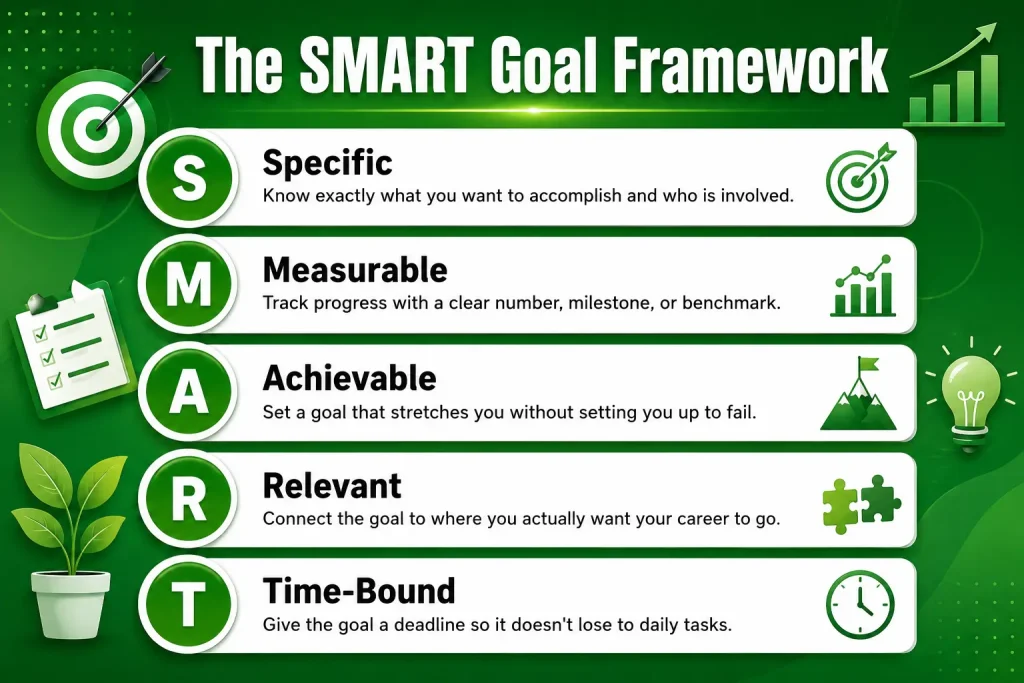
A — Achievable: Stretch Without Snapping
A good goal challenges you without setting you up to fail. Ask: Is this realistic given my current time, skills, and resources? What support do I need to get there?
Weak goal: “I will become a certified project manager in one month.”
SMART version: “I will complete a beginner project management course over three months and apply what I learn to one small team project.”
R — Relevant: Connect the Goal to Your Career Vision
A relevant goal supports where you actually want to go. Ask: Does this move me closer to my career goals? Is now the right time to pursue it?
Weak goal: “I’ll learn graphic design because it seems interesting.”
SMART version: “I will strengthen my data storytelling skills, since clear reporting is the top skill gap my manager flagged for my next promotion.”
T — Time-Bound: Build Urgency and Momentum
Every goal needs a deadline, or it will keep losing to more urgent tasks. Ask: What is my deadline? How can I break this into weekly or monthly checkpoints?
Weak goal: “I want to grow my professional network.”
SMART version: “I will attend two industry networking events per quarter and follow up with three new contacts within a week of each event.”
How to Set SMART Goals for Professional Development: A 5-Step Process
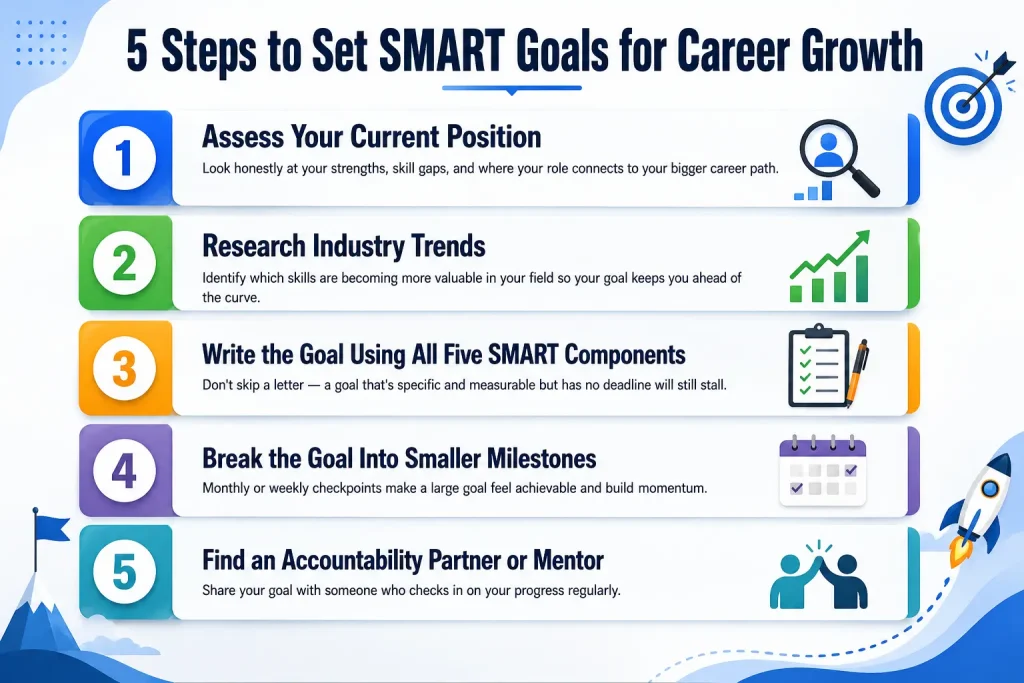
- Assess your current position. Take an honest look at your strengths, skill gaps, and how your current role connects to where you want to go.
- Research industry trends. Identify which skills are becoming more valuable in your field so your goal keeps you ahead of the curve rather than catching up later.
- Write the goal using all five SMART components. Don’t skip a letter — a goal that’s specific and measurable but has no deadline will still stall.
- Break the goal into smaller milestones. Monthly or weekly checkpoints make a large goal feel achievable and give you regular wins to build momentum.
- Find an accountability partner or mentor. Share your goal with someone who will check in on your progress — accountability consistently outperforms willpower alone.
10 SMART Goal Examples for Professional Development
Use these as templates. Swap in your own numbers, deadlines, and resources to make each one yours.
1. Technical Skill Development
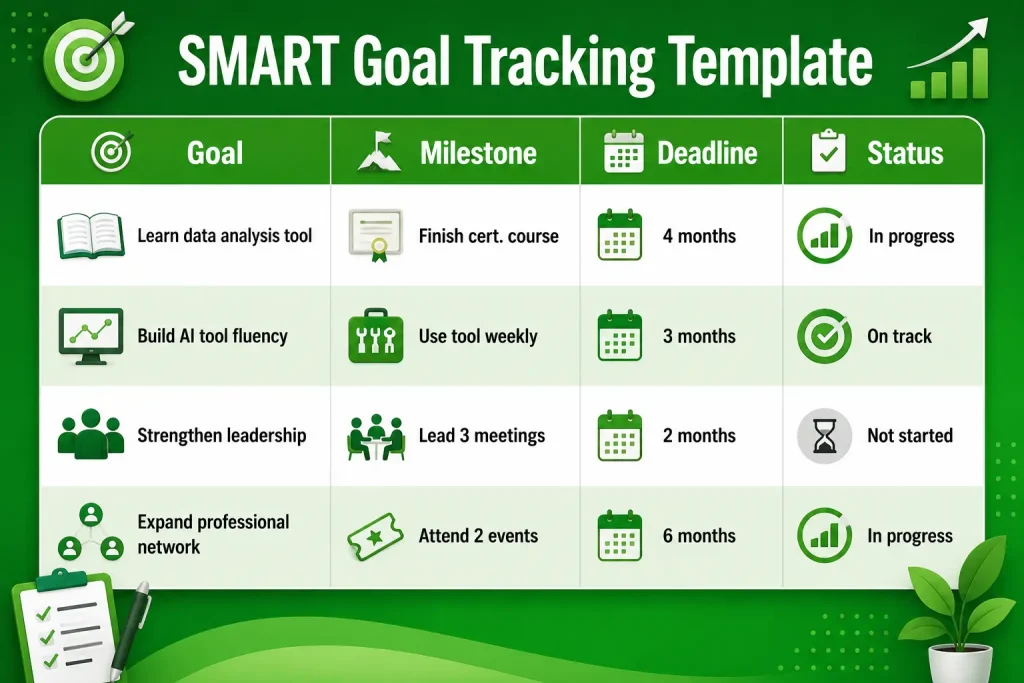
- Specific: Learn a data analysis tool relevant to my role.
- Measurable: Complete an online certification and apply it to one real project.
- Achievable: Dedicate two hours per week to coursework.
- Relevant: Data skills are increasingly required across my department.
- Time-bound: Reach working proficiency within four months.
2. AI and Digital Literacy
- Specific: Build confidence using AI tools relevant to my day-to-day work.
- Measurable: Complete one introductory AI fundamentals course and use one AI tool at least once a week, documenting what works.
- Achievable: Choose a single tool rather than trying to learn several at once.
- Relevant: AI fluency is quickly becoming a baseline expectation across most roles.
- Time-bound: Reach comfortable, independent use within three months.
3. Leadership Development
- Specific: Strengthen team leadership through clearer communication and delegation.
- Measurable: Lead three team meetings and collect feedback after each one.
- Achievable: Use my company’s existing leadership coaching program.
- Relevant: Leadership skills directly support my path toward a management role.
- Time-bound: Apply these strategies within the next two months.
4. Communication and Soft Skills
- Specific: Improve written communication through a business writing course.
- Measurable: Submit five practice reports for feedback.
- Achievable: Set aside one hour weekly for the course.
- Relevant: Clear writing is essential for the client reports I own.
- Time-bound: Complete the course within three months.
5. Building a Professional Network
- Specific: Expand my network within my industry.
- Measurable: Attend two networking events per quarter and connect with five new people at each.
- Achievable: Use my company’s professional development budget to cover event costs.
- Relevant: A stronger network opens doors to collaboration and new opportunities.
- Time-bound: Complete this goal within six months.
6. Certification or Credentialing
- Specific: Earn a project management certification.
- Measurable: Pass the certification exam with a score of 85% or higher.
- Achievable: Enroll in a prep course and study five hours weekly.
- Relevant: This credential strengthens my case for a promotion.
- Time-bound: Earn the certification within six months.
7. Personal Branding
- Specific: Build a stronger professional presence on LinkedIn.
- Measurable: Publish one industry insight weekly and grow engagement by 30%.
- Achievable: Spend 30 minutes daily on content and networking.
- Relevant: A visible personal brand attracts new opportunities and credibility.
- Time-bound: Achieve this within three months.
8. Finding a Mentor
- Specific: Find a mentor who has experience in the role I want next.
- Measurable: Reach out to three potential mentors and schedule an initial conversation with each.
- Achievable: Use my professional network and alumni community to identify candidates.
- Relevant: Mentorship accelerates career growth and helps me avoid avoidable mistakes.
- Time-bound: Confirm an ongoing mentor relationship within two months.
9. Cross-Department Shadowing
- Specific: Understand how a department outside my own operates.
- Measurable: Shadow one colleague from that department for a half-day and document three key takeaways.
- Achievable: Coordinate with my manager to free up the time.
- Relevant: Broader organizational knowledge improves cross-team collaboration.
- Time-bound: Complete the shadowing within one quarter.
10. Work-Life Balance and Wellbeing
- Specific: Reduce work-related stress and protect personal time.
- Measurable: Commit to a firm 5 p.m. sign-off three days per week.
- Achievable: Block the time on my calendar and communicate the boundary to my team.
- Relevant: Sustainable energy is what makes long-term career growth possible.
- Time-bound: Maintain this consistently for the next six months.
Applying SMART Goals in the Workplace
SMART Goals for Career Advancement
When it comes to getting promoted or a new job, SMART goals are a great way to make your case ahead of time rather than waiting for an opportunity to fall into their lap. Design a career path with your manager, sign up to be part of an obvious project, and meet regularly with leaders in departments that interest you. Check in on your progress quarterly, making adjustments as necessary.
Performance Review SMART Goals
Arriving at a review with specific, quantifiable objectives is a sign of initiative and self-awareness, which are desirable qualities in any supervisor. If you have been given feedback in a previous review then use that as a SMART goal for the next review.
SMART Goals for Teams and Managers
The same system can be applied to a team to drive them towards a common goal. With respect to the employee experience, Gallup’s data indicates that there is a consistent correlation between employee engagement, revisiting goals, receiving regular feedback, and better performance — all of which structured goals offer.
Quick-Win Goals for When You Feel Stuck or Overwhelmed
If a full SMART goal feels like too much right now, start smaller. These low-pressure wins build momentum without requiring a big planning session:
- Update your LinkedIn profile with one recent achievement.
- Spend 30 minutes this week reading an article or listening to a podcast in your field.
- Message one existing contact just to check in or share something useful.
- Block 15 minutes to write down three skills you’d like to build this year.
- Try one new productivity or AI tool for a single task.
Common Goal-Setting Mistakes to Avoid
- Setting too many goals at once. Two or three meaningful goals beat ten shallow ones.
- Being too rigid. Circumstances change, and revising a goal is a sign of good judgment, not failure.
- Setting goals in isolation. Sharing your goal with a mentor or colleague adds accountability and perspective you can’t get alone.
- Writing goals that are vague by habit. If you can’t picture the finish line, the goal needs more specificity.
How to Stay Accountable and Track Progress
Motivation fades — accountability systems don’t have to. Pair your SMART goal with a simple tracking method:
- Use a spreadsheet, goal-tracking app, or plain notebook to log weekly progress.
- Find an accountability partner: a colleague, friend, or mentor who checks in on your progress on a set schedule.
- Celebrate milestones, not just the finish line — small wins keep motivation alive over a multi-month goal.
Reviewing and Resetting Your Goals
Goals aren’t permanent. Set a monthly or quarterly check-in to ask: Am I making progress? Has anything changed that affects this goal? Do I need to adjust my timeline or approach? Treat this review as routine maintenance, not a sign that something went wrong.
SMART Goals vs. Performance Goals vs. OKRs
| Framework | Best Used For |
| SMART Goals | Individual growth goals with a clear, single deadline — ideal for professional development. |
| Performance Goals | Evaluating output tied to your current job responsibilities, usually set by a manager. |
| OKRs (Objectives & Key Results) | Aligning a team or company around an ambitious objective measured by several key results, usually reviewed quarterly. |
SMART goals and performance goals often get confused. A performance goal measures how well you’re doing your current job right now. A professional development goal — best written using the SMART framework — is about building the skills that prepare you for where your career is headed next.
Conclusion
Career success doesn’t just happen — it’s a plan. One SMART goal at a time can help you take steps to improve your organization, by providing a step-by-step approach that is structured and repeatable. Set one goal; discuss it with someone who will keep you on track; review it often. Every goal you achieve is an additional brick in the wall of your career and life.
FAQs
There are 5 FAQs about SMART Goals for Professional Development
What are SMART goals for professional development?
They are those SMART goals that are used by professionals to develop their skills, enhance their careers, and measure progress at work that is meaningful.
How often should I review my professional development goals?
Check your goals on a monthly or quarterly basis. Check-ins are really beneficial to ensure you stay on task, realize what needs to be tweaked, and are aware of just how much progress you’ve made.
Do SMART goals work for soft skills like communication or leadership?
Yes. For instance: “Go to one communication workshop, and learn one new technique for each team meeting in 30 days.
How many SMART goals should I set at once?
It’s ideal to shoot 2-3 goals per time period. Having multiple at once is distracting and reduces the quality of progress on each of them.
What’s the difference between a professional development goal and a performance goal?
Performance objectives are short-term and goal setting oriented, and they are related to your current job duties and short-term performance. Professional development objectives are about developing skills that you want to have in the future, so you can move into another position.
Can SMART goals be used for AI or technology skill-building?
Yes, and it’s one of the most useful applications these days. A potential objective: Take a beginner’s course on AI tools and use 1 new tool to your weekly work for three months and document how time is saved.