Introduction
The majority of individuals begin their day by picking up their phone, going through their notifications, and already feel behind even before they leave the bed. It need not be so. The 5-5-5-30 Morning Routine is an easy, systematic practice requiring only 45 minutes and has been assisting thousands of individuals to change their energy, concentration and attitude in 2026. You do not have to rise at 4 AM or have an intricate strategy. All you need is 45 minutes, a dose of regularity and the desire to appear on your side every morning.
Table of Contents
What Is the 5-5-5-30 Morning Routine?
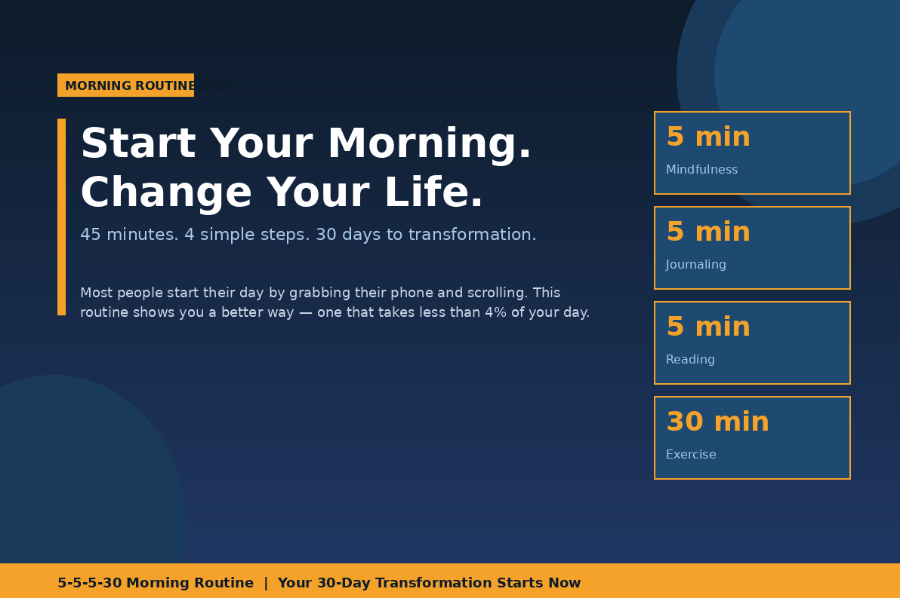
This is a basic routine that divides your morning into four blocks that are short, yet powerful. All of them address a variety of aspects of your well-being: mental, emotional, intellectual and physical.
This is on a breakdown basis:
5 minutes: Mindfulness or deep breathing.
5 minutes: Journaling or gratitude
5 minutes: Reading or affirmations.
30 minutes: Physical activity or movement.
This routine is beautiful because of its simplicity. It is pleasingly direct – brief, crisp and efficient in stimulating energy and concentration. No gym membership, no costly equipment or a life coach is required. It will only take you 45 minutes, and dedication to yourself.
This routine also has a fitness-oriented version. That workout consists of 5 squats, 5 push-ups, 5 lunges, and a 30-second plank – all of which are aimed to increase dopamine and leave you feeling happier right after starting to move. Both versions work. The one you select will be based on your objectives.
Why Your Morning Sets the Tone for Everything
Before plunging into each of these steps, it is good to know why mornings are so important. You are the most awake and least distracted during the first hour after waking up. Cortisol – the natural wake up hormone in your body is highest in the morning, so your concentration and ability to make decisions is at its best.
By waking up at the same time, drinking water in the morning, exposure to light, and mild exercise, you give your nervous system a strong message that it is time to get going. That change alone can make you feel more awake, relaxed and able to cope with whatever the day has in store.
Cortisol peak, decision-making ability and emotional regulation of your brain are all circadian patterns – and the initial 60 minutes of your day set the stage on all three. Guard that window and all is casey.
Breaking Down Each Step
Step 1: 5 Minutes of Mindfulness or Deep Breathing
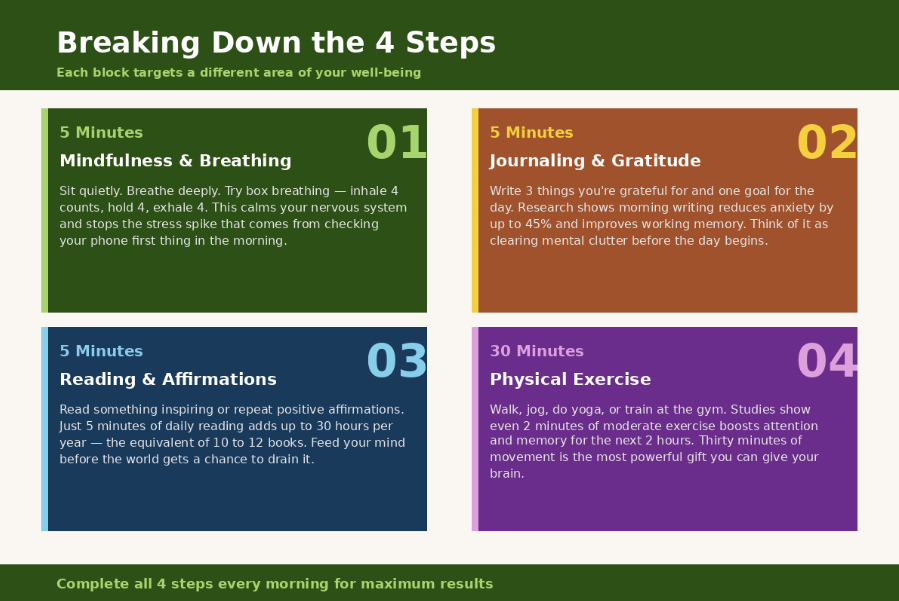
Most people check their phone in the morning as the first thing they do. It is among the worst habits that you can possess. Checking emails or social media before your brain is awake evokes a stress response before you even get out of bed.
Rather, take five minutes to breathe. You might practice box breathing – breathe in 4 counts, 4 counts hold, breathe out 4 counts, 4 counts hold. Or just sit there and shut your eyes and concentrate on slow and deep breaths. Regular meditation reconfigures the default mode network and decreases rumination. Five minutes will be sufficient to relax your nervous system and put a serene mood.
You don’t need to be an expert meditator. Free guided meditations of less than five minutes can be found in apps such as Calm or Headspace or Insight Timer. The idea is simply to begin your day intentionally, rather than distractedly.
Step 2: 5 Minutes of Journaling or Gratitude
When you have settled your mind, then it is time to turn your head. Take 5 minutes to write in a journal. This doesn’t need to be elaborate. You can list three things you are thankful, one day goal or just your mood.
It has been found that morning writing decreases anxiety by 20-45 percent, enhances working memory, and produces a compound effect on self-awareness in the course of weeks. Five minutes of work is a lot of pay.
Meditation, journaling, gratitude are among the practices that can enhance focus and emotional stability, and the ability to wake up with a relaxed and positive attitude can make a significant difference in overall performance. Consider journaling as clearing the mind trash before the day starts. It sweeps out room to think.
Step 3: 5 Minutes of Reading or Affirmations
The third block concerns nourishing your brain with something good and progressive. Take 5 minutes to read a book, a chapter of something that motivates, or reciting affirmations aloud.
Five minutes of reading a day will give you about 30 hours of reading a year the amount of reading 10 to 12 books worth. Reading 10-20 pages of a non-work book activates your brain without putting pressure on it, whereas affirmations and visualization help you to think positively and be confident.
Select personal development, health, business, or any other books that are of interest to you. This is aimed at learning something new and preparing your brain to be in growth mode before day needs take over.
Step 4: 30 Minutes of Physical Activity
This is the most powerful block of the entire routine. It takes your brain less than half an hour of exercise to do more than pretty much any other stuff you can do in the morning.
A study that was published in the journal Translational Sports Medicine, indicates that two minutes of moderate to high intensity exercise can benefit the span of attention, focus, learning, and memory within two hours of the event. Suppose a half an hour will do.
You don’t need to run a marathon. Below are the choices depending on the fitness level:
Novices: 30 minutes of fast walking outside.
Intermediate: A home exercise – squats, push-ups, lunges, and planks.
Advanced training: HIIT, jogging, cycling or gym training
Low energy days: 30 minutes of yoga or light stretching.
The trick is to exercise your body regularly. It is all about consistency, not perfection. You can always do something even when you are tired, but you cannot do nothing.
The Science behind Why It Works
This habit is not only trendy, it is supported by the research. The four pillars of this company are aimed at different biological systems and when they unite they are a very strong domino effect.
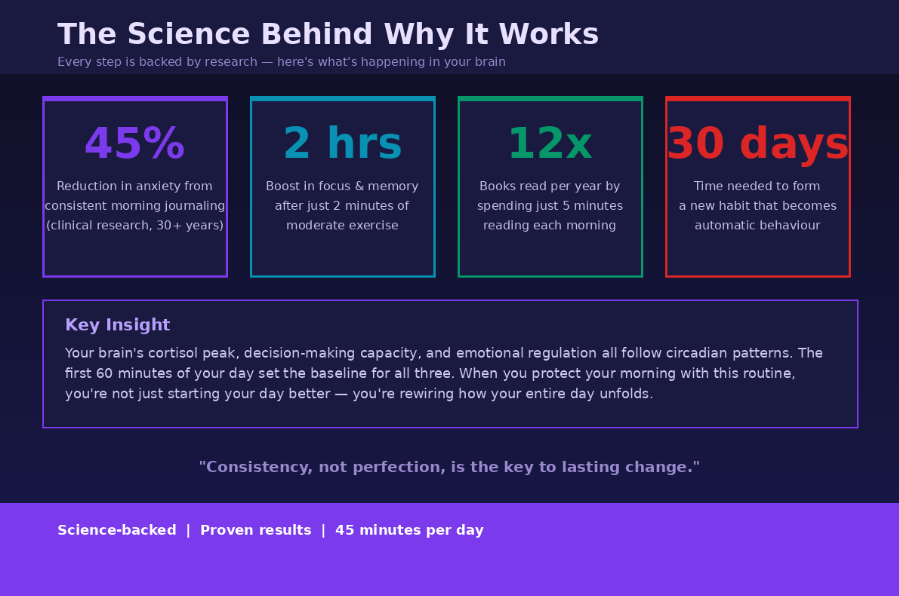
The meditation reduces the amount of cortisol and in turn, activates the parasympathetic nervous system- your rest and restore system. Your thoughts are taken out of your mind through journaling and this eliminates mind clutter and anxiety. Neuroplasticity or the capacity of your brain to make new connections is activated by reading. Exercise overwhelms your body with the endorphins, dopamine, and serotonin, the three-chef of mood and focus chemicals.
A majority of the energy issues are not the result of not being motivated enough – it is the result of inappropriate signals to your nervous system and circadian rhythm. The body desires consistency, light, hydration, movement, and stable blood sugar particularly in the early part of the day. This routine provides all that within a matter of less than an hour.
Your 30-Day Transformation Plan
Knowing what to do is one thing. Another one is actually doing it on a 30-day basis. This is a basic week in, week out schedule to help this routine be habitual:
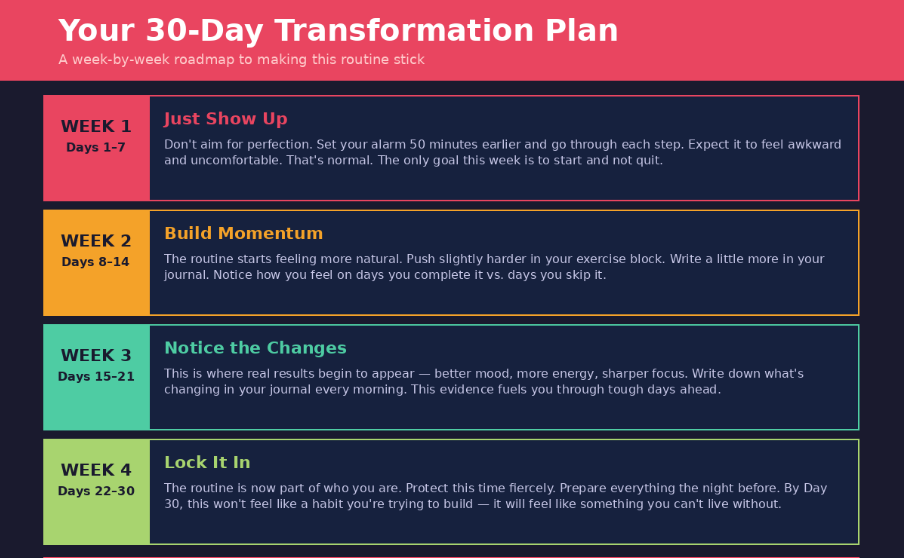
Week 1: Just Show up No need to do it perfectly. Get up an hour and a half early (50 minutes earlier than normal) and just follow the process. This week is only to begin. Anticipate it to be uncomfortable.
Week 2: Establish Momentum At this point, the routine ought to become a little more familiar. Work a bit harder in your exercise block. Attempt a more lengthy journaling note. Begin to observe the feeling you have on the days you do it and the days you miss.
Week 3: Track the Changes It is during this week that most of them begin to see actual results- better mood, more energy, clear thinking. Write down what’s changing in your journal each morning. The treasure you gather here will nourish you on any bad days to come.
Week 4: Lock It In By Week 4, this will be less of a need to be forceful and more of a non-negotiable aspect of your day. Guard this time with thy fiery hand. Say no to early meetings. Get it all ready the night before – journal, workout clothes, water bottle.
A danger to note: there will be a minor trough between Day 10 and Day 12. This is normal. Virtually, everyone reaches a point where they feel bored and lacks the drive to keep on doing it. Push through it. It is that dip that is building the habit.
Common Mistakes That Will Derail Your Routine
Despite the greatest intentions, individuals fall into errors when beginning to create a new morning routine. The most usual ones to be avoided are these:
Omissions of the soft steps: A lot of individuals leap to workouts and overlook meditation and journaling. Don’t do this. Physical steps are not the only crucial ones, so are the mental. They get your brain ready to work like no exercise can.
Fancy it on Day 1: You do not require scented candles, a sunrise alarm clock and custom-made playlist to get you going. Keep it simple. All it takes is a pair of sneakers, a notebook, and a pen.
Stopping with a single missed day: You can skip a day without spoiling your progress. Two days off begins a new habit – the habit of quitting. When you miss one day, report the following day and no one will fault you.
Failure to plan the day before: The night before you make or break your morning routine. Ready yourself by packing clothes, gym bag, water bottle and workspace. The night before, it is easy to reduce friction and present oneself in the morning without any trouble.
How to Customize This Routine for Your Life
One size doesn’t fit all, and that’s okay. The following is how to adjust the routine to your situation:
Busy parents: Do meditation and journaling before the children get up, exercise during their school time or nap time. Splitting the routine is even.
On Day 1, night owls: Do not attempt to wake up at 4 AM. Move your alarm 15 minutes later each day of a three days period until you are at your desired wake time.
Remote workers: Make this routine your fake commute. It reminds your brain that you are starting a workday- this assists in focusing and boundaries between work and life.
As a fitness newbie: Begin with 10 to 15 minutes of movement and gradually increase to 30 minutes in 2 weeks. Two or three weeks later, your body will adjust to the new rhythms provided you remain consistent.
Regardless of your way of life, the framework is the same. It is just the details that change.
What You Can Expect After 30 Days
In the course of your first month, you should expect the following:
Mentally: The person becomes less anxious, has more concentration and feel more in control of their day. All you need is to journal and change your whole attitude in 30 days.
Physically: You will have more energy all day, sleep well at night and you will notice an improvement in strength or stamina depending on the type of exercise you do.
Emotionally: Greater sense of self-discipline and confidence. And when you fulfill a promise to yourself every morning, it develops confidence in yourself – and this transfers to all other areas in life.
Productivity: Many people find they accomplish more before 9 AM than they used to accomplish all morning. Starting the day with wins creates momentum that lasts.
Conclusion
This is the time to revamp your mornings, should you have been considering it. The 5-5-5-30 Morning Routine only requires 45 minutes of your time, less than 4 percent of the total day, and yields results that can transform every aspect of your life. You do not have to be an early morning person, fitness fanatic and a meditation master. You just need to start. The 30 days that follow are going to go by whether you like it or not. All one needs to ask is, what do you want to be after those 30 days? Start tomorrow morning. Your self to come will appreciate you.
FAQs
Q1. What exactly is the 5-5-5-30 morning routine?
It is a structured morning habit made up of four blocks: 5 minutes of mindfulness, 5 minutes of journaling, 5 minutes of reading or affirmations, and 30 minutes of exercise — totaling 45 minutes.
Q2. How long does it take to see results from the 5-5-5-30 routine?
Most people begin noticing improvements in energy and mood within 7 to 10 days. More significant changes in focus, fitness, and emotional well-being typically appear by the end of 30 days.
Q3. Can I do this routine if I’m not a morning person?
Yes. Start by waking up just 15 minutes earlier than usual and gradually shift your alarm back every few days. Your body adjusts to new sleep patterns within two to three weeks of consistency.
Q4. What if I only have 20 minutes in the morning?
Shorten each block. Do 3 minutes of breathing, 3 minutes of journaling, 3 minutes of reading, and 10 to 15 minutes of exercise. A shorter version is always better than skipping it entirely.
Q5. Do I need any equipment or apps to get started?
No equipment is required. A notebook, a pen, and comfortable clothes are enough. Optional apps that can help include Calm or Headspace for meditation and Loop Habit Tracker for consistency tracking.