
Introduction
How Does Setting Goals Lead to Success? When they become trapped or don’t know what to do next, they ask this question. The reality is that goals don’t push you in the right direction, they shift the way your brain processes information, prioritizes work and keeps you motivated over time. A goal provides a mental target for your mind to try and reach your desired wish. If you want to start a new job, gain new skills, be healthier, or develop new habits, the science of goal setting offers an explanation for whether people accomplish their objectives or they give up. There, you’ll discover that there is science, and there is a step-by-step framework to follow.
Table of Contents
What Is Goal Setting, Really?
Goal setting is nothing more than establishing goals and then outlining how to achieve them. Obviously, most people don’t go through the “defining a path” step. They desire something without ever writing down what is needed to achieve it.
It was first studied formally by psychologist Edwin Locke in 1968, and subsequently, with Gary Latham, to create what is now known as goal-setting theory. Their research revealed that setting specific goals that were also challenging resulted in better performance than setting general goals such as “do your best. Their research shows that setting specific goals, that were difficult, were the best way to perform, as opposed to general goals such as “do your best. Since then this concept has been applied to various sales teams, athletes, students, and patients in physical therapy with similar success.
The difference between goal setting and just wishing for something is the structure you are obliged to put in place. A wish remains a wish forever. A goal has a clear outcome, a time frame and typically a means to determine if you reached the goal. That is the structure that makes dreams come true and where one person’s dream can become another’s.
The Science of How Setting Goals Actually Leads to Success
Goals Give Your Brain a Filter
There’s an overload of information competing for your consciousness every day. It’s a filtering system in the brainstem known as the reticular activating system (RAS) that helps it manage. If you establish a clear objective, your RAS is telling it to focus on that.
That’s what happens when you have finally decided to purchase a particular vehicle, and then start seeing it everywhere. You didn’t change anything about the world, it just began to look for you. Whether you’re thinking about your career, your finances, or your health, a clear goal will change what your brain is paying attention to—and taking action for—day by day.
Goals Build Motivation and Momentum
It has also been shown that challenging goals elicit more effort and persistence than easy goals, provided that the person believes he or she can attain the goal (Locke and Latham’s studies). The “just right” balance between “too easy to be important” and “too hard to try. A goal that pushes you is just the right amount of tension to keep you interested.
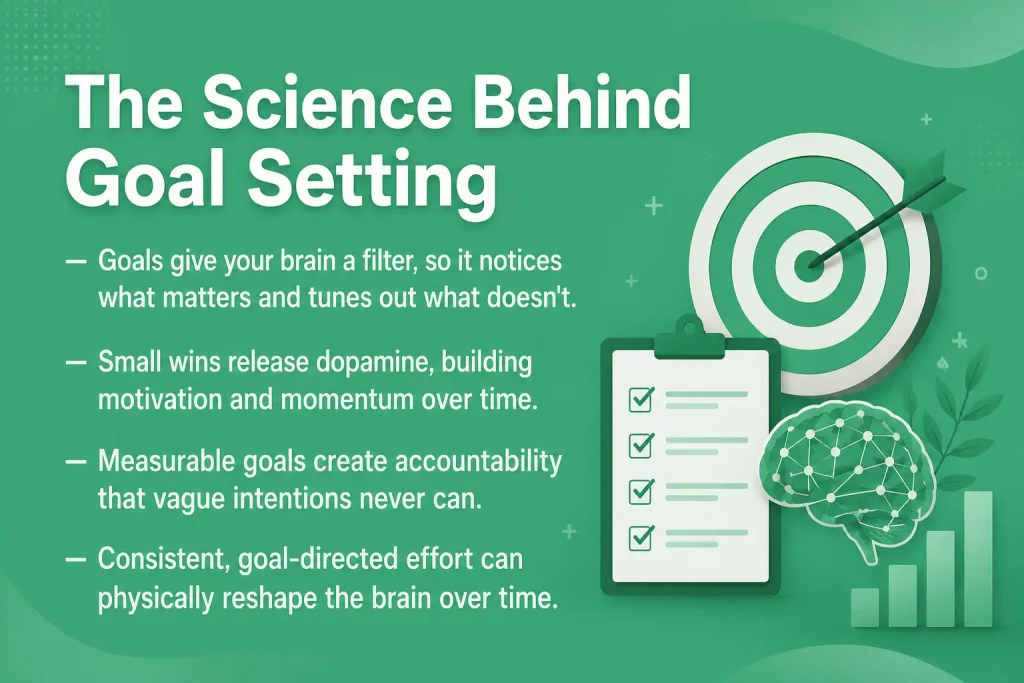
Each of these small victories releases the brain’s reward chemical, dopamine, which reinforces the action that caused the reward, increasing the momentum. That’s why breaking big goals into smaller milestones is so effective because you’re getting another reward from your brain every time you achieve a milestone, which helps you to keep moving forward rather than getting stuck.
Goals Create Accountability You Can Measure
It is hard to assess the effectiveness of unclear goals. If you’re still feeling unwell, you don’t have anything to compare with, right?If you’re still not feeling good, then you have nothing to compare to, right? Every day, you will get a yes or a no answer to the question of whether you will walk for 30 minutes, five times a week or not.
It is because this measurability makes goals functional instead of aspirational. If you can measure it in numbers or show it on a graph, you will be able to identify problems early on, modify your plan and be honest with yourself about your current progress against your ambition.
Goals Physically Reshape Your Brain
Studies of neuroplasticity have demonstrated that repetitive behavior that is purposeful and engages in a goal can alter the structure of the brain over time. One of the most notable findings is the study of patients with multiple sclerosis who were instructed with specific health objectives, and improvements in these patients were determined when compared to control patients. With repeated and purposeful effort, the brain adapts, in other words.
This is an important thing for anyone pursuing a personal objective or career, not just for their clinical patient. Habits that are connected to a clear goal reinforce (strengthen) the neural pathway that connects to that behavior, which is one reason why habits with a goal work better than habits with a non-specific will.
With each repetition, it compounds over time. Things that used to be on the conscious mind — reflecting on the pattern, going to the gym, sitting down to write, start to become automatic. At this point, the objective has not only given results, but it has also changed the way in which the goal is going to be reached in the future, as well.
Goal-Setting Statistics worth Knowing in 2026
Numbers provide a context for the theory. Recent studies and surveys reveal the facts about goal setting and follow-through:
Recent behavioral research on resolution outcomes shows that about 80-90% of New Year’s resolutions end up failing within the first few months.
Research at the Dominican University of California has also shown that people who recorded their goals were some 42 percent more likely to accomplish them than those who did not.
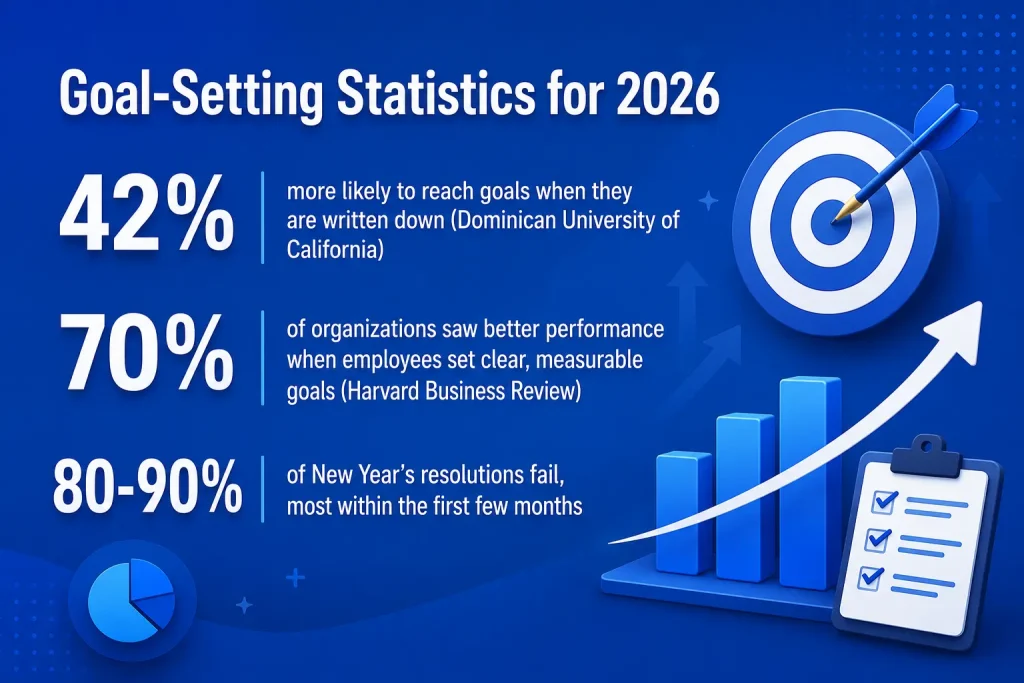
According to a 2013 Harvard Business Review study, 70 percent of respondents reported improved performance at their company when employees have clear, measurable goals.
According to one long-term measurement, just about 8 percent of people who make New Year’s resolutions end up keeping them until the end of the year.
Research on goals for lifestyle changes reports that the rate of goal attainment ranges widely depending on the type of goal, with financial and health-related goals having lower follow-through than goals which involve specific, scheduled actions.
Writing goals, specificity and structure are repeated as the pattern in almost every study in terms of predicting better outcomes than motivation and willpower alone.
A Step-by-Step Framework for Turning Goals Into Success
Step 1: Define a Clear Vision
Get specific about the destination; not general about the direction. The direction is I want a better career. Your vision can become a reality within 18 months: “I want to be a certified project manager within 18 months.”
Write it somewhere that you see frequently. An idea that remains in your head is much more easily lost or forgotten to oneside if the world gets busy.
Step 2: Make It SMART
After defining your vision, narrow it down with the SMART method: Specific, Measurable, Achievable, Relevant and Time-bound. Each element takes care of one of the common reasons on why goals may not be achieved. Specific and measurable stop the vagueness; achievable and relevant stop you from chasing the wrong thing; time-bound stops indefinite delay.
For instance, a SMART goal could be, “Save $6,000 for an Emergency Fund by December 2026 by saving $500 per month.
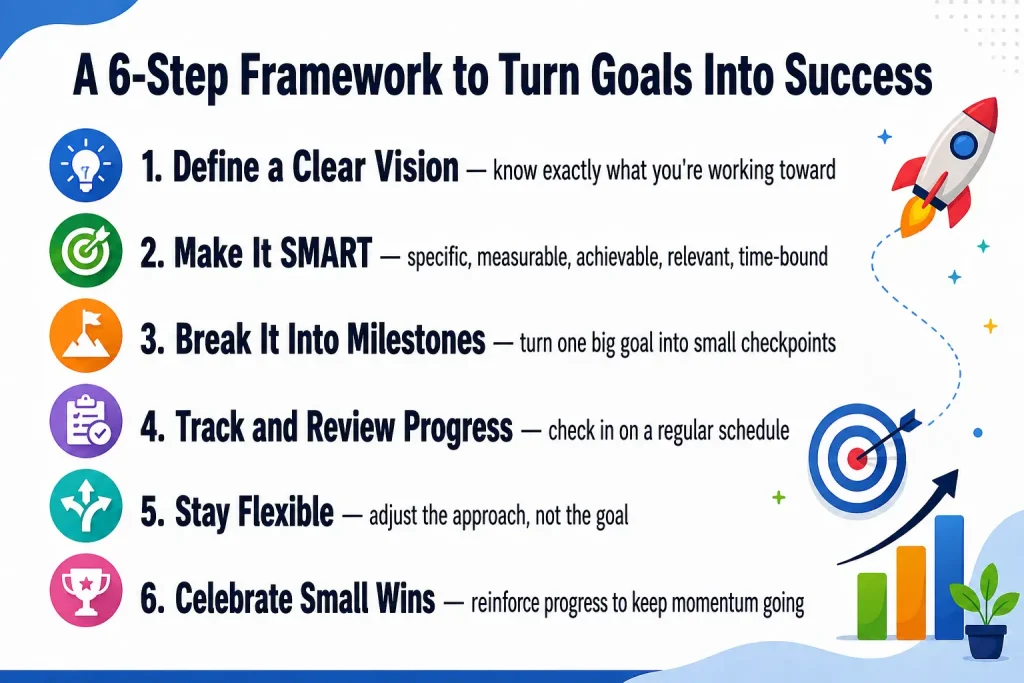
Step 3: Break It Into Milestones
Big objectives do not appear overwhelming when you split them up into smaller parts. Write a book? Set a weekly word count instead of a word count for the book. If it is a career change, work on one certificate, or one networking meeting at a time.
The milestones are points of review. If you hit it, you’re on track, and if you miss, you’re on time to make adjustments before it is too late to do so and the whole goal is lost.
Step 4: Track and Review Progress
Establish a schedule (weekly is good for most goals) for reviewing progress against plan. It doesn’t matter what tool you use as long as it’s the same every day: a notebook, spreadsheet, or app.
Ask what went well, what didn’t go so well and what needs to be changed in each review. This creates a feedback loop for goal setting instead of a one and done approach.
Step 5: Stay Flexible
Things change and a good goal setting system anticipates that. If your original strategy is no longer working, change the way you are doing it but don’t give up on the goal.
If, for example, someone is a baker whose bakery got disrupted by a lockdown, they may switch to online classes or home delivery rather than abandoning the idea of owning a bakery. The end objective remains unchanged, but the route winds through a real-world challenge.
Step 6: Celebrate Small Wins
Celebrate achievements – both large and small. This isn’t a treat, it’s reinforcement. Celebrating progress helps maintain the motivation cycle, and it makes the next step in motivation easier.
It doesn’t have to be costly. It doesn’t take much to keep that momentum going — maybe a favorite meal, an afternoon off or just a good victory shouted out.
Common Mistakes That Sabotage Goal Setting
Even well-intentioned goal setters run into the same handful of pitfalls. Being aware of them ahead of time makes them much easier to avoid.

- Setting too many goals at once, which splits attention and willpower until none of them get proper focus.
- Choosing goals based on what others expect rather than what you actually want, which drains motivation quickly.
- Skipping the milestone stage and only measuring success at the very end, which removes any early warning signs.
- Never writing goals down, relying on memory and motivation alone to carry the plan forward.
- Treating a missed deadline as total failure instead of a signal to adjust the approach.
Most of these mistakes share a common thread: they treat goal setting as a single event instead of an ongoing process that needs regular attention.
Real Examples: How Goal Setting Turns Into Success
Career
A junior employee who wants to be promoted could set the objective of being able to lead one cross-team project in the next 6 months or 2 quarters instead of just saying “want to move up. This specificity gives them a specific thing that they can act on during each meeting and each discussion with their manager.
Health
A person looking to get fit may establish a target of running three times per week for three months to finish a 5K race. The finish line and the training plan is derived from the same SMART goal and makes it easier to make decisions day-by-day.
Finance
If it’s a goal such as “Pay off $4,000 worth of credit card debt in 10 months with a monthly payment of $400”, it’s not a number that’s overwhelming anymore, it’s a monthly action. Giving monthly updates on the decreasing balance helps maintain motivation.
Education
A student who is having trouble with an upcoming test can choose to study one chapter each two days instead of studying more. This makes a frightening task into an arranged, monitored routine which lessens last minute cramming.
In each of the four domains, everything starts with an abstract desire, which evolves into a concrete plan to take a specific action, and which transforms into a tangible result that can be observed. But it’s that change, more than any single trick or app, that’s the true way to make goal setting a reality that leads to success in the real world.
Conclusion
How Do Goals Lead To Success? The key: a clear, written goal tells your brain what to aim for, and with an aim, your focus, motivation and follow-through changes. Don’t need to have dozens of goals and a complicated system. It takes a clear vision, a SMART organization, small steps, honest tracking, and flexibility to adjust when things change. Include regular review and celebration and you create a system that is not against your psychology, it is with it. Most people don’t succeed simply because they don’t make a plan. Start small today.
FAQs
What percentage of goals actually succeed?
Estimates vary by study and goal type, but most research puts overall success rates for unstructured goals like New Year’s resolutions in the single digits to low double digits. Goals that are written down, broken into milestones, and reviewed regularly show significantly higher completion rates than vague, unstructured ones.
Why do most goals fail?
Most goals fail because they’re too vague, lack a specific timeline, or have no system for tracking progress. Without milestones or regular review, it’s easy to lose momentum and quietly abandon the goal without noticing until much later.
How long does it typically take to achieve a goal?
This depends entirely on the size and complexity of the goal. Smaller, well-defined goals can be achieved in weeks, while larger goals like career changes or major fitness transformations often take six months to two years when broken into consistent milestones.
What is the most effective goal-setting method?
The SMART framework remains one of the most widely used and research-supported methods, largely because it directly targets the most common reasons goals fail: vagueness, unrealistic scope, and no deadline. Pairing SMART goals with regular progress reviews tends to produce the best long-term results.
Can setting too many goals at once hurt your progress?
Yes. Psychologists refer to this as goal competition, where multiple goals compete for the same limited time, attention, and willpower. Focusing on one or two primary goals at a time, and only adding more once early milestones are met, generally produces better outcomes than juggling many goals simultaneously.